Pin It
 The first time I encountered a King Cake, I was standing in a New Orleans kitchen on a gray January morning, watching my friend's grandmother unfold a kitchen towel to reveal this impossibly golden, sugar-crowned ring. She explained the tradition with the casual confidence of someone who'd made it a hundred times—the hidden baby, the purple and green and gold, the way you're supposed to host next year's party if you find it. I bit into a slice still warm from the oven and understood immediately why this cake had survived centuries: it's sweet, fragrant with cinnamon and nutmeg, and deeply tied to the joy of gathering people around a table.
I made this cake for the first time on a whim during a Mardi Gras party I was throwing, not really knowing if it would work or if anyone would care. My partner wandered into the kitchen halfway through and just stood there watching the dough rise, occasionally peeking under the towel like it was a sleeping child. When we pulled it out of the oven golden and fragrant, we didn't even wait for the icing to set before tearing into a piece. The whole party gathered around the kitchen island, each person nervously taking a slice, half-joking about finding the baby. Someone did, and suddenly the entire evening shifted—there was this beautiful, ridiculous moment where everyone was invested in something simple and joyful.
Ingredients
- Warm milk: Room temperature is crucial here—too hot kills the yeast, too cool and nothing happens, so use a thermometer if you have one.
- Active dry yeast: This is what makes the magic happen, creating that tender, airy crumb that makes King Cake so special.
- All-purpose flour: Don't sift unless you want to, but do measure by spooning and leveling for consistency.
- Unsalted butter: This lets the spices shine through without competing flavors.
- Eggs: They bind everything together and add richness that keeps the cake moist for days.
- Salt, nutmeg, and cinnamon: These three work in harmony—the nutmeg adds warmth and depth, while cinnamon is the star.
- Light brown sugar and butter filling: Simple but essential; this is where the flavor intensity lives.
- Powdered sugar, milk, and vanilla: The icing should be thin enough to drizzle and set slightly glossy.
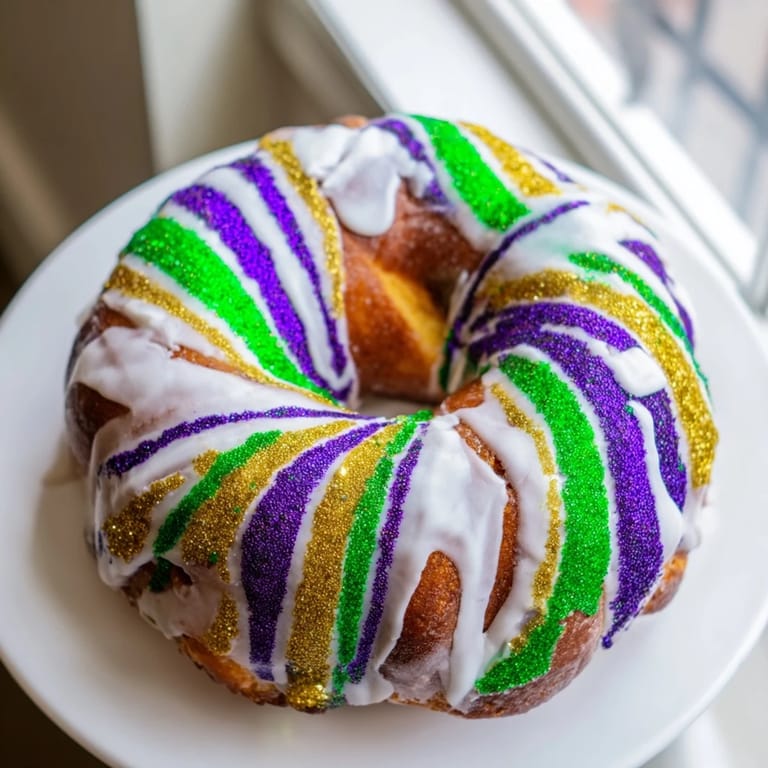
- Colored sugars: Use the vibrant, coarse kind that sparkle and don't dissolve into the icing—the visual element is half the tradition.
- Plastic baby figurine: Food-safe, small enough to hide in a slice, and absolutely optional unless you're embracing the full tradition.
Tired of Takeout? 🥡
Get 10 meals you can make faster than delivery arrives. Seriously.
One email. No spam. Unsubscribe anytime.
Instructions
- Wake up the yeast:
- Combine yeast, a tablespoon of sugar, and warm milk in a small bowl and let it sit for 5–10 minutes until it's foamy and alive on top. If it doesn't foam, your yeast is dead and you need to start over.
- Build your dough:
- Mix flour, remaining sugar, salt, and spices together, then add the butter and eggs along with that foamy yeast mixture. Stir until everything comes together, then transfer to a floured surface.
- Knead with intention:
- Work the dough for 8–10 minutes, pushing it away with the heel of your hand and folding it back over itself until it's smooth, elastic, and springs back slightly when you poke it. This develops the gluten and gives you that tender structure.
- First rise:
- Place the dough in a greased bowl, cover it with a towel, and let it sit in a warm spot until it's doubled in size—usually 1–1.5 hours. Your kitchen should feel cozy and smell like yeast and spices.
- Fill and shape:
- Punch down the risen dough and roll it out into a rectangle about 10 by 20 inches. Spread softened butter across the surface, then sprinkle the cinnamon-sugar mixture evenly, leaving a small border.
- Roll and ring:
- Starting from the long side, roll the dough tightly toward you, creating a long log. Pinch the seam to seal, then carefully connect the ends to form a ring, pinching them together firmly so they don't unravel during baking.
- Second rise:
- Place your ring on parchment paper, cover it loosely, and let it puff up for 45–60 minutes while you preheat your oven to 350°F. The dough should look pillowy and full of promise.
- Bake until golden:
- Slide the King Cake into the oven and bake for 25–30 minutes until the top is deep golden brown and it smells absolutely incredible. It's done when a toothpick inserted into the thickest part comes out clean.
- Cool with patience:
- Let the cake cool completely on a rack before icing—this prevents the glaze from melting into puddles. Waiting is hard, but worth it.
- Ice and decorate:
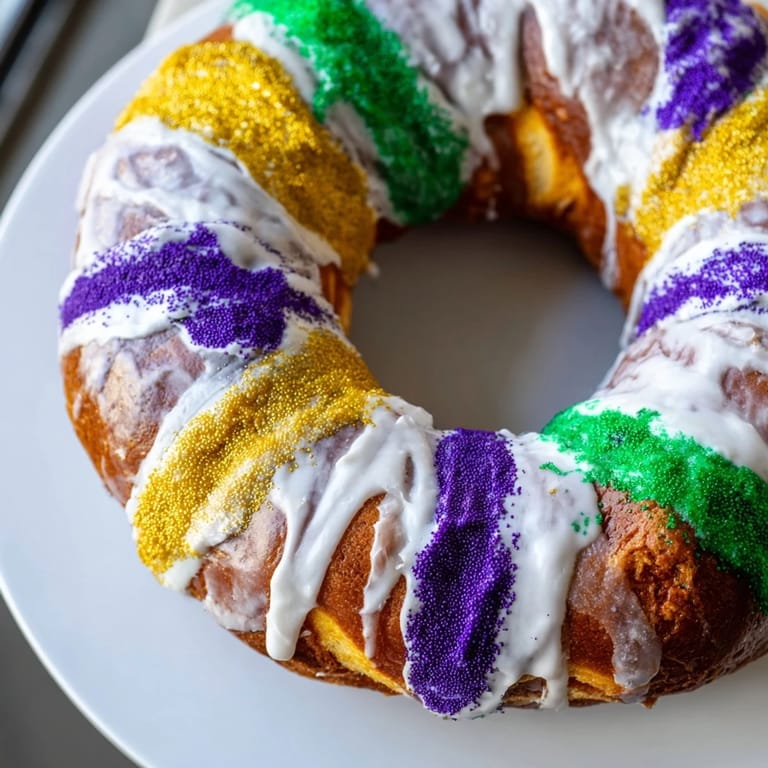
- Whisk powdered sugar, milk, and vanilla until it's smooth and pourable, then drizzle it over the cooled cake in whatever pattern feels right. While the icing is still wet, immediately sprinkle colored sugars in alternating bands of purple, green, and gold.
- Insert the tradition:
- If you're using a baby figurine, carefully tuck it into the bottom of the cake just before serving, making sure it's secure and guests know to be careful while eating.
 Pin It
 What struck me most wasn't the cake itself, but what happened around it—the way my friend's eight-year-old nephew held his slice like it was precious cargo, peering into every bite with genuine suspense, the way someone finding the baby turned into an unexpected honor instead of a joke. That's when I understood that King Cake isn't really about the spices or the technique; it's about creating a moment where tradition and playfulness collide, where a simple ring of bread becomes an excuse to gather and celebrate together.
The Science of Spices
Nutmeg and cinnamon do something special when they're baked into yeast dough—they become mellow and integrated rather than sharp or overwhelming. The warmth of nutmeg rounds out the cinnamon's brightness, creating a spiced flavor that feels sophisticated but approachable, festive but never cloying. I've learned to resist adding more than the recipe calls for, because restraint here is what makes people keep coming back for another slice.
Making It Your Own
The cream cheese filling variation mentioned in the original notes is genuinely worth trying if you want something richer and slightly tangier—mix 8 ounces of cream cheese with a quarter cup of sugar and a teaspoon of vanilla, then spread it over the dough before the cinnamon sugar. Some people add a touch of orange zest to the filling, or swap the colored sugars for sparkly white and silver, or even drizzle chocolate over the icing before it sets. The beauty of King Cake is that it's flexible enough to absorb your personal touches while still remaining unmistakably itself.
Serving and Storing
King Cake is best enjoyed the day you make it, while the crumb is still soft and the icing has that slight glossy finish, but it keeps beautifully wrapped in plastic wrap for two days after baking. Serve it slightly warm or at room temperature, ideally with strong coffee or a glass of sparkling wine—the bubbles cut through the sweetness in a way that feels celebratory. If you're hosting the party where someone finds the baby, make sure everyone at the table knows the tradition and the delicious responsibility that comes with finding it.
- Slice with a serrated knife for the cleanest cuts and prettiest presentation.
- If you're making this for a crowd, consider baking two rings instead of one—they go faster than people expect.
- Wrap any leftover slices individually so they stay fresh and are easy to grab for breakfast or dessert.
 Pin It
 Making a King Cake connects you to centuries of celebration, but it also creates something immediate and intimate in your own kitchen. That's the real magic—not the hidden baby or the colorful sugar, but the fact that you made something beautiful that brings people together.
Recipe FAQs
- → What makes King Cake unique?
Its ring shape coupled with vibrant purple, green, and gold sugars and a hidden tiny figurine create a festive touch.
- → How is the dough prepared?
The dough is yeast-based, enriched with butter, eggs, and spices like cinnamon and nutmeg, kneaded until elastic, then left to rise twice.
- → What filling is used inside the King Cake?
A mixture of brown sugar and cinnamon spread over softened butter adds a sweet, spiced layer inside the rolled dough.
- → How is the colorful decoration applied?
After baking and icing with a vanilla glaze, colored sugars are sprinkled in alternating bands while the icing remains wet to ensure adhesion.
- → Are there any traditional serving suggestions?
King Cake pairs well with coffee or sparkling wine and is often enjoyed during Mardi Gras festivities.
- → Is the hidden figurine edible?
No, the plastic figurine is not edible and should be removed before eating. It is a fun part of tradition.